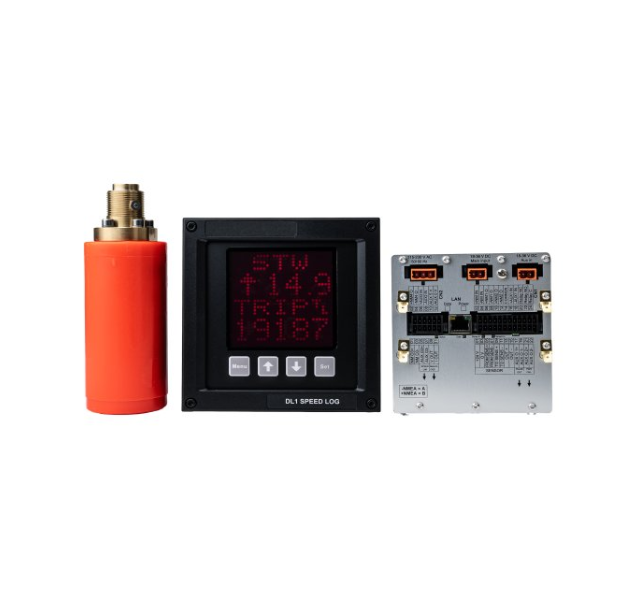
Single-Axis Doppler Speed Log System
The SKIPPER DL1-Multi measures a vessel’s longitudinal speed and distance through water using Doppler technology. Combining a single hull-mounted sensor, a compact bridge display, and a separate electronic unit, the system provides real-time navigation data with flexible installation and interface options. Water temperature measurement and web-based configuration further support onboard operation and maintenance.
Key Benefits
Single-axis speed-through-water and distance measurement.
Longitudinal speed range of ±50 knots.
Water temperature measurement.
Compact LED dot-matrix display with full night dimming.
Three user-programmable display views with integrated menus.
Web-based configuration, calibration, and diagnostics.
NMEA 0183, pulse, and LAN interface options.
Tank or sea-valve installation for different hull arrangements.
Doppler Speed-Through-Water Measurement
The DL1-Multi uses the Doppler principle to measure vessel speed relative to the surrounding water. It provides longitudinal speed and distance data, with a specified minimum water depth of 3 m below the transducer. Speed accuracy is stated as better than 0.2 knots or 2%, whichever is greater, with a speed resolution of 0.1 knot.
Compact Bridge Display
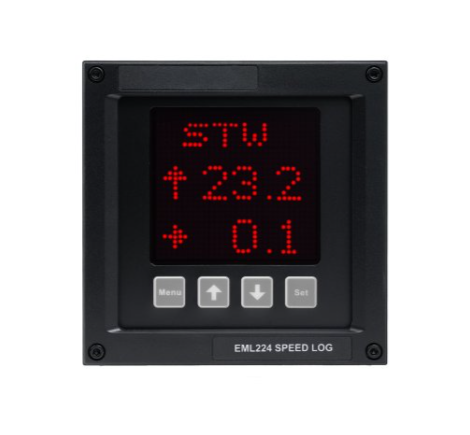
The compact display features a 28 × 30 LED dot matrix with full night dimming. Three user-programmable views and integrated menus allow operators to select the information presented. The display supports bracket or panel mounting, while the separate electronic unit can be positioned to suit onboard connection requirements.
Flexible Interfaces and System Integration
The JB70D1 electronic unit supports pulse, NMEA 0183, and LAN interfaces, allowing integration with equipment such as VDRs, conning displays, repeaters, and radar systems. Connections include four NMEA 0183 outputs, one optically isolated NMEA 0183 input, three isolated outputs, an alarm relay, and an IEC 61162-450 LAN interface. A web interface provides access to setup, calibration, and diagnostics.
Installation and Alarms
The system uses a single sensor installed in a tank or sea valve. Mounting options accommodate single- or double-bottom hull arrangements, with steel or aluminium tank options. A standard 40 m sensor cable supports installation flexibility. Alarm functions cover high and low speed limits, power failure, and sensor failure.



















Single-Axis Doppler Speed Log System
The SKIPPER DL1-Multi measures a vessel’s longitudinal speed and distance through water using Doppler technology. Combining a single hull-mounted sensor, a compact bridge display, and a separate electronic unit, the system provides real-time navigation data with flexible installation and interface options. Water temperature measurement and web-based configuration further support onboard operation and maintenance.
Key Benefits
Single-axis speed-through-water and distance measurement.
Longitudinal speed range of ±50 knots.
Water temperature measurement.
Compact LED dot-matrix display with full night dimming.
Three user-programmable display views with integrated menus.
Web-based configuration, calibration, and diagnostics.
NMEA 0183, pulse, and LAN interface options.
Tank or sea-valve installation for different hull arrangements.
Doppler Speed-Through-Water Measurement
The DL1-Multi uses the Doppler principle to measure vessel speed relative to the surrounding water. It provides longitudinal speed and distance data, with a specified minimum water depth of 3 m below the transducer. Speed accuracy is stated as better than 0.2 knots or 2%, whichever is greater, with a speed resolution of 0.1 knot.
Compact Bridge Display
The compact display features a 28 × 30 LED dot matrix with full night dimming. Three user-programmable views and integrated menus allow operators to select the information presented. The display supports bracket or panel mounting, while the separate electronic unit can be positioned to suit onboard connection requirements.
Flexible Interfaces and System Integration
The JB70D1 electronic unit supports pulse, NMEA 0183, and LAN interfaces, allowing integration with equipment such as VDRs, conning displays, repeaters, and radar systems. Connections include four NMEA 0183 outputs, one optically isolated NMEA 0183 input, three isolated outputs, an alarm relay, and an IEC 61162-450 LAN interface. A web interface provides access to setup, calibration, and diagnostics.
Installation and Alarms
The system uses a single sensor installed in a tank or sea valve. Mounting options accommodate single- or double-bottom hull arrangements, with steel or aluminium tank options. A standard 40 m sensor cable supports installation flexibility. Alarm functions cover high and low speed limits, power failure, and sensor failure.